In 2024, the World Economic Forum and the McKinsey Health Institute published a report about the disparities women face in accessing health care. Closing the women’s health care gap, the findings show, could boost economies worldwide by as much as $1 trillion by 2040 – and collectively give women millions more years of life.
At the University of South Carolina, faculty members in multiple fields are working to address these disparities. From experts in public health and exercise science to nursing and primary care, USC researchers are tackling the issues that underlie the women’s health care gap while contributing to the health and well-being of all South Carolinians.
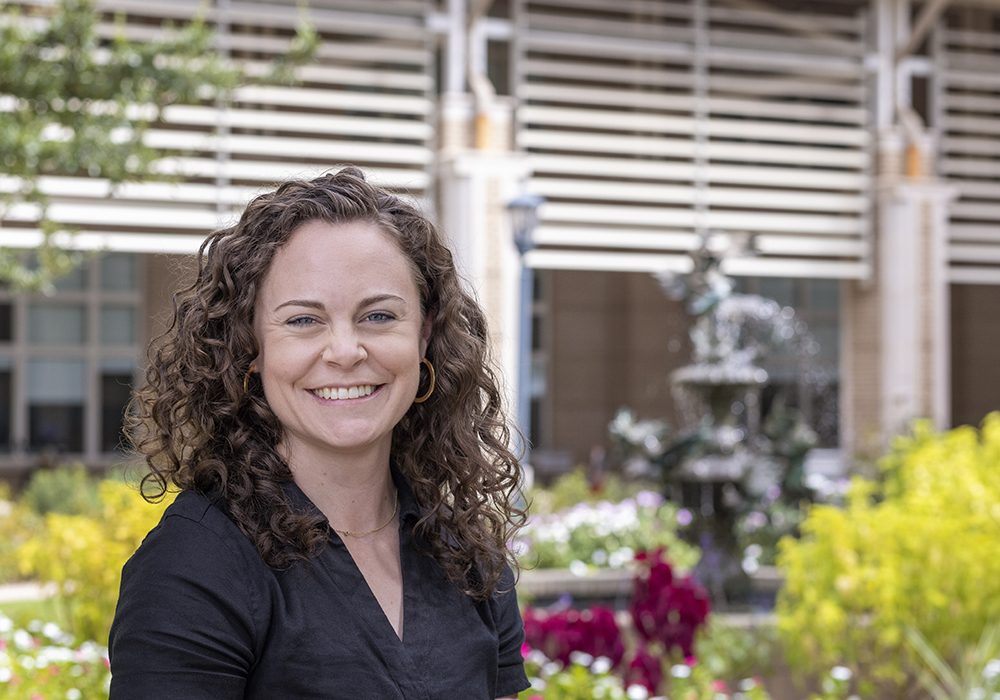
In the Arnold School of Public Health, assistant professor Katie Hirsch is working to address one of the main reasons for the gap in women’s health care: the research shortage.
“A 2021 study showed that only 34% of all participants in sports science research are female, and only 6% of studies are done on females specifically,” Hirsch says. “When I came to USC and decided to focus on women’s health, I realized there are a lot of barriers even in our ability to study women, which is why there’s a lack of research.”
Traditionally, scientific research has taken findings based on the ‘typical’ male body and extrapolated the results to apply to all people, including women. The problem, Hirsch says, is that “women are not small men.”
“While there are similarities between men and women as humans, scientists recognized that women’s bodies are different. Their hormones are fluctuating, and they knew this might have an impact. But instead of addressing that, many decided it’s easier to study issues in men and apply it to the women. That’s where that phrase comes into play,” she says.
The physiological differences between men and women come down to more than meets the
eye. In addition to the ways women are socialized differently from their male counterparts,
the changes in women’s hormones – not only during the month but across the lifespan
– significantly affect how their bodies function.
“I realized that maybe we just need better methods. We’ve been using the same methods
for years, but they were designed to study men. We need to refine our methods and
bring in some new approaches to be able to answer these questions.”
“Hormones are not the only factor. They’re just a piece of the puzzle, but it’s a piece of the puzzle that’s very real for women,” Hirsch says. “We should account for and address those differences between men and women, but it is more expensive and there are more logistics to work out.”
In the exercise science field, these logistics in research may look like factoring in a female participant’s monthly hormone cycle. At certain points in the cycle, some women may feel the effects of symptoms like fatigue or headaches, triggered by changes in her hormones, and this in turn may impact her exercise performance. If the researcher is trying to isolate the effects of a nutrition protocol on her athletic performance, the onset of symptoms could complicate the findings.
“We always see variability in the data, but changes in hormones could create even more variability,” Hirsch says. “The research in my sphere now is looking at how much impact hormones have on some of our basic measures. When do I need to be careful and account for hormones? But also, how might the participant’s cycle change over time?”
To address these questions, Hirsch is incorporating new methods to include women into research with the goal of removing barriers that have deterred scientists from including women previously.
“I realized that maybe we just need better methods. We’ve been using the same methods for years, but they were designed to study men. We need to refine our methods and bring in some new approaches to be able to answer these questions,” she says.
One such method involves gathering daily hormone measures from participants. Recent advancements in fertility research have given rise to smartphone compatible devices that measure the primary female sex hormones from a urine sample. The test can be done at home every morning, with results in a matter of minutes.
“For the first time, we can see the daily hormone changes across a menstrual cycle. This allows us to not only consider hormone levels, but also the patterns and fluctuations that characterize the female hormone environment,” she says. “Incorporating this method into my work has improved feasibility and accuracy in conducting studies that consider the effects of hormones on physiological outcomes.”
This method has also shown promise for studying women with non-traditional, dysregulated or changing hormone patterns. Women's cycles can vary widely from person to person and even month to month, and some women use hormone replacements. Menopause complicates things even more, as women see their cycles change and experience a new set of symptoms.
Hirsch says she’s looking forward to a solution that is just now emerging: Wearable devices are being used in work addressing fertility issues to track the fluctuations in a woman’s hormones each day, moment to moment.
“They’re developing something like continuous glucose monitors, but instead they’re tracking hormones. We have the technology now to track your hormone changes pretty much live. We can see the patterns, and then we can use tools like AI to analyze those large sets of data and understand what the information means,” she says.
Hirsch expects these devices will start appearing more commonly in the next five years, and AI itself holds promise as a tool to remove some of the barriers to including women in medical and exercise science research.
“AI came at a good time. We needed this technology to even begin addressing some of this. I don’t know how we would have done it before,” she says.
Learn how another USC researcher is addressing bias in health care settings.