by Harper Moody
One afternoon in my U.S. History class, my teacher told us that her friend was almost deported. This, of course, raised questions from my classmates. Our interests were piqued more than normal in history class because this was a real-life topic. We asked about how deportation actually works, how immigrants can become citizens, what is required to pay taxes, and other random questions. Through our interrogation, we discovered that none of us really knew how these laws were being enforced. Most questions were met with a collective shrug, an implicit acknowledgment of our shared cluelessness.
The girl behind me said, “We should learn more about today’s topics.”
Someone across the room added, “Yeah, why don’t we?”
This was met with another collective shrug and the common sentiment that all of us should do more research, despite knowing that many of us were unlikely to follow up on that.
All of this is to say that if South Carolina is to be improved, the first step is to eliminate ignorance. Not just about current political hot topics – though they are important – but also about general life and society in modern South Carolina.
When first met with the question of how to improve our state, my first reaction was that I had no idea. Then it became obvious: that is the problem. That is what should be improved. We must educate those for whom the answer is not immediately apparent. We want the youth to be aware of what is happening in the state and in people’s lives outside of our suburban towns. Where and why are people suffering? What can our leaders do to lessen the struggle? What can each citizen do to bear the load?
These are all things I want to know and things we should want the youth to know. We want to be able to form our own well-educated ideas, opinions, and solutions that will direct our future as South Carolinians. How can we do this if we don’t know the reality of our situation?
In South Carolina public schools, we are required to take a certain number of history courses; however, most content doesn’t extend beyond the 2010s. Its temporal boundaries don’t diminish its importance, but they limit how useful our education can be toward improving the state. Why not teach a current events course? If we can create whole textbooks on civilizations thousands of years old, we can teach about life right in front of us. We can become comfortable with constantly evolving subject matter. We can risk talking about possibly taboo subjects (in the most objective way we can) so that the next generation of leaders can have an understanding of the world apart from For You pages and our parents’ opinions.
Public education should focus not only on history, language, mathematics, and sciences, but on the exact functions, regulations, and conditions of how people exist in the modern world, not only at the state level, but at the international level as well. We should learn who our representatives are, the specifics about living conditions in other cities, the current state of our economy and employment rates, and different perspectives on new laws, to name a few. By having this kind of knowledge as highschoolers, we will be given a head start in finding our role in society. This will result in a populace of aware and involved young adults who are ready to take their place as the next residents of South Carolina, set on improving the state for years to come.
Even after learning what the problem is, the answer to the question of how to improve South Carolina may be different for every person. Maybe there are so many possibilities that it would take more than a high school class to cover them all. But research can be done, curricula can be written, discussions can be held, and solutions can be created to usher in the next generation of politicians, teachers, policy analysts, and public servants who will drive our state and country toward the best it can be. Steps must be taken to educate future South Carolinians about the state and country in which they live. If that’s what it takes to raise South Carolina to its fullest potential, then it’s worth it a thousand times.
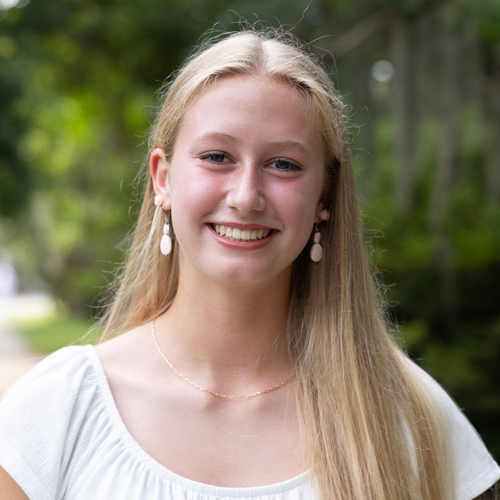
About Harper Moody
Harper Moody is a junior at Wando High School in Mount Pleasant, where Jeannie Fox is her AP Language and Composition teacher. The daughter of Rebecca and Blake Moody, Harper enjoys reading, watching movies, and playing soccer. She plans to study English and Secondary Education in college, with hopes of becoming a high school English teacher.