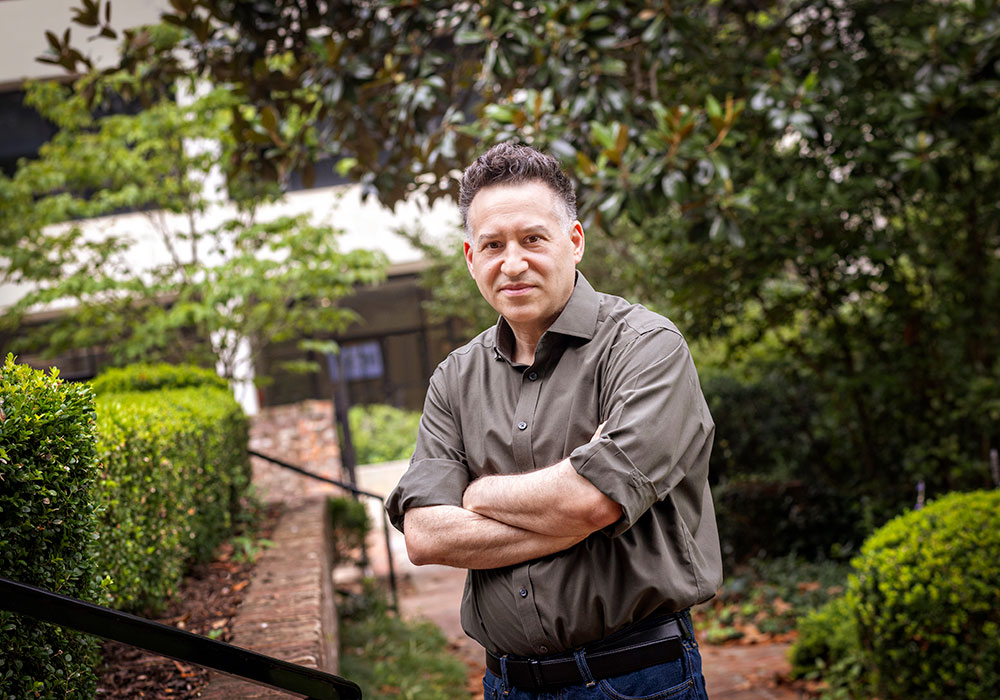
Brett Sherman was never nervous about teaching. Going into the classroom as a graduate teaching assistant at Princeton, he looked forward to the opportunity. “I was excited to teach, I remember that,” says Sherman, now an associate professor of philosophy at the University of South Carolina. “I was kind of wide-eyed and green and excited to try.”
And he was even more excited by the subject matter, which captured the Long Island, New York native’s attention early. In ninth grade, he joined his school’s debate team. In tenth, a professor recommended a couple of texts on eastern philosophy. Around the same time, a friend made a passing reference to Nietzsche. His curiosity was piqued.
“In some ways I was not a typical undergraduate, and not a typical philosophy major, in that I knew in high school that I wanted to major in philosophy in college and become a philosophy professor,” he says. “My mother says she told me I should be a philosophy major. I don't remember that, but I assume that that's correct. I think she recognized that I had an interest in analytical reasoning.”
The seed really took root, though, when Sherman attended a jazz bass performance at a local bookstore. He was there for the music — he played double bass in an orchestra growing up, then switched to electric bass — but his interests drifted that evening when he found himself in the philosophy section and plucked a random book off the shelf.
“I started reading this book while listening to the music, and something just clicked,” he says. “I was reading stuff that I was in no way prepared to understand, but I was enjoying it. After that, I would go back to the bookstore and read even more stuff I didn't understand.”
“Any sort of inquiry makes certain assumptions, invokes certain concepts, and there are always questions that can arise about those assumptions and concepts. There's no such thing as philosophy-free science, in that sense. In my research and in my teaching, I'm interested in rethinking some of those assumptions, coming at things from a different direction and seeing what results.”
It's a familiar, perhaps even relatable image: the precocious teenager enamored by the world of ideas, the budding intellectual diving in at the deep end. “I remember I bought this ridiculous big fat book on Spinoza and read like 50 pages with absolutely no context.” He chuckles. “I was going about it all wrong, but I was interested in it.”
As a scholar who studies language and epistemology, Sherman now understands the art of philosophical inquiry as well as anyone. As a teacher, he wants his students to catch the same bug. “That mixture of confusion and excitement has stayed with me, and now I try to cultivate that in my students,” he says.
Beyond that, he hopes his students will apply what they learn and practice in his classroom to other disciplines, and to discourse more broadly.
“Any sort of inquiry makes certain assumptions, invokes certain concepts, and there are always questions that can arise about those assumptions and concepts,” he says. “There's no such thing as philosophy-free science, in that sense. In my research and in my teaching, I'm interested in rethinking some of those assumptions, coming at things from a different direction and seeing what results.”
In a sense, he is getting at the nature of philosophy itself, at least as he defines it.
“If people ask, ‘What is philosophy?’ nobody agrees,” he says. “But when I think about how I conceive of my work, I think of philosophy as being unique among academic disciplines in that other academic disciplines are typically defined by their subject matter. Philosophy, or at least the project that I'm engaged in, is defined more by its position in inquiry than by the subject matter of the inquiry.”
He uses a specific example, same as he would in an intro-level course taken by as many minors and non-majors as majors: “Whereas a historian might ask, ‘What caused the Civil War?’, a philosopher might ask, ‘What does it mean for one thing to cause something else?’”
And while some philosophers may prefer to wrestle with those sorts of questions through their scholarship, Sherman delights in having those exchanges in real-time with undergrads.
“There's something attractive about not just kind of doing this by myself,” he says. “There’s something attractive about trying to explain something, trying to talk through it and see how you can make a case.”